Social Work Temporary Assistance to Needy Families Quizlet
Which States Are Givers and Which Are Takers?
And is that even the correct fashion to frame the question?
Updated on March eight, 2017.
Maps showing regional differences among Americans are all the rage these days, such as this depiction of the contours of baseball fandom, or this ane of the beers we're alleged to favor, or this showing the places in America where none of u.s. lives, or this artistic video/map showing where Americans employ different words for common things such as soda.
For my coin, one of the more than interesting maps appearing recently came from the personal-finance website WalletHub. Analysts there gear up out to decide how states compare in terms of their reliance on federal funding.
The WalletHub analysts substantially asked how much each land receives dorsum as a return on its federal income-tax investment. They compared the 50 states and the District of Columbia on 3 metrics: (1) federal spending per capita compared with every dollar paid in federal income taxes; (2) the percent of a state's annual revenue that comes from federal funding; and (three) the number of federal employees per capita. The third measure received just half the weight of each of the others in the calculation.
What the resulting map shows is that the most "dependent states," equally measured past the composite score, are Mississippi and New Mexico, each of which gets dorsum virtually $iii in federal spending for every dollar they send to the federal treasury in taxes. Alabama and Louisiana are shut behind.
If you look only at the offset measure—how much the federal regime spends per person in each state compared with the amount its citizens pay in federal income taxes—other states stand up out, particularly South Carolina: The Palmetto State receives $7.87 back from Washington for every $1 its citizens pay in federal tax. This bar chart, made from WalletHub's data, reveals the sharp discrepancies among states on that measure out.
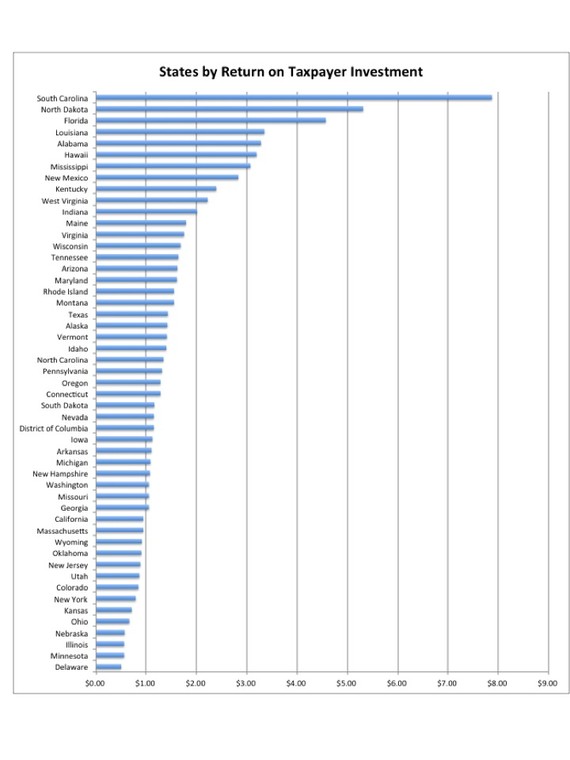
On the other side of this group, folks in xiv states, including Delaware, Minnesota, Illinois, Nebraska, and Ohio, go back less than $1 for each $ane they spend in taxes.
It's not just that some states are getting way more than in return for their federal tax dollars, simply the disproportionate amount of federal help that some states receive allows them to keep their own taxes artificially low. That's the argument WalletHub analysts make in their 2014 study on best and worst states to be a taxpayer.
Role of the explanation for why southern states boss the "most dependent" category is historical. During the many decades in the 20th century when the South was solidly Democratic, its congressional representatives in both the House and the Senate, enjoying great seniority, came to concord leadership positions on powerful committees, which they used to transport federal dollars dorsum to their home states in the form of contracts, projects, and installations.
Another part of the explanation is easier to discern. The reddest states on that map at the top—Mississippi, Alabama, Louisiana, New Mexico, Maine—have uncommonly high poverty rates and thus receive disproportionately large shares of federal dollars. Through a variety of social programs, the federal regime disburses hundreds of billions of dollars each year to maintain a "safety net" intended to assistance the neediest among us. Consider, for case, the percentage of each state'southward residents who go nutrient stamps through the federal government's SNAP programme. This nautical chart tells the story.
Another way of getting at the same indicate is to map the percentage of families in 2012 with incomes below the federal poverty level (co-ordinate to the Census Agency's ACS five-year estimate). This map, made through Social Explorer, shows the information at the county level: The darker the shading, the higher the percent of impoverished residents.
You can get here to see an interactive version of this map that enables yous to whorl your cursor over counties and go pop-up information showing the percentages for any specific county. You can besides change the map view, showing the data at dissimilar levels, ranging from states all the fashion down to private census block groups. (To see the mapped data at sub-canton levels, you accept to zoom way in to particular areas.)
There are diverse ways of thinking nigh what WalletHub's "state dependency" map tells us. 1 approach is to smoothen calorie-free on the cherry-red-states-equally-takers paradox: Dominated by Republican voters who profess their distaste for the federal authorities and its social programs, these are the very states that rank highest on the dependency alphabetize. That, for example, is how Concern Insider handled the story:
Who really benefits from authorities spending? If you listen to Rush Limbaugh, you might think it was those blue states, packed with damn hippie socialist liberals, sipping their lattes and providing gratis abortions for bored, horny teenagers. ...
As it turns out, it is carmine states that are overwhelmingly the Welfare Queen States. Yes, that's right. Red States—the ones governed past folks who think government is too large and spending needs to exist cut—are a net bleed on the economic system, taking in more than federal spending than they pay out in federal taxes. They talk a good game, only stick Blue States with the bill.
Fair enough. That'due south a catchy perspective. And there are few things more fun than exposing hypocrisy.
Alternatively, nosotros could use the "state dependency" map as an opportunity to reflect on a different paradox—the long-continuing role of the far-away federal regime equally an amanuensis of community. Because of federal programs, people in places like Southward Carolina and Mississippi are getting a helping hand not from their neighbors a few blocks away or in the next county over, but from residents of Delaware, Minnesota, Illinois, and Nebraska. Whether you similar that idea depends, in part, on how you lot personally reconcile the tension betwixt ii long-cherished, core American values—our passion for individualism and our regard for community—and whether you see "customs" every bit encompassing the whole state.
That's a far more interesting matter to think about (though possibly less viscerally satisfying) than which states are moochers or freeloaders and which are getting fleeced.
gordonberaing1955.blogspot.com
Source: https://www.theatlantic.com/business/archive/2014/05/which-states-are-givers-and-which-are-takers/361668/
0 Response to "Social Work Temporary Assistance to Needy Families Quizlet"
Post a Comment