How Do You Know if Your Dogs Trachea Is Damaged?
Are Dogs Really Smiling at Us?
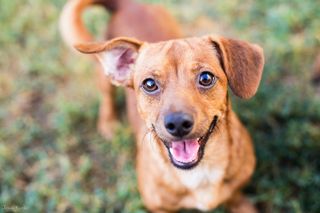
The dog'due south oral fissure opens wide, her lips pull upward at the corners, and her tongue lolls out. Virtually would await at this confront and see an unmistakable grin. Simply is that actually what'southward going on here? Practice dogs use this expression in the same way as people, to convey their joy, pleasure or contentedness?
In other words, are dogs really smiling at us?
The answer has roots in our thirty,000-twelvemonth history of keeping dogs as domesticated animals. Thanks to that history, humans and dogs have developed a unique bond, which has too made dogs very useful subjects for the report of advice. "Studying dogs is a really unique opportunity to look at social communication betwixt species," said Alex Benjamin, an associate lecturer in psychology, who studies domestic dog cognition at the Academy of York in the United kingdom of great britain and northern ireland. [20 Weird Dog and Cat Behaviors Explained past Scientific discipline]
Virtually of this research also reinforces the thought that the chatty bond we share with dogs is unique. For instance, researchers have plant that dogs encompass the homo gaze and utilize eye contact in a way that few other animals practise.
A report published in the journal Current Biological science tested how wolves and dogs would respond to the impossible chore of opening a container to get at some meat they knew was within. The researchers found that while the wolves would simply stalk off when they discovered they couldn't open it, dogs would turn around and give humans a long, inquiring gaze — suggesting that these animals knew a person could assist them consummate the task.
Another study, published in the periodical Scientific discipline, constitute that both dogs and humans experience an increment in levels of oxytocin — a hormone that plays a office in social bonding — when they lock eyes with one another. Even more intriguing, dogs that sniffed oxytocin would then spend more than time staring at humans.
"[A shared gaze] is the primal machinery for cooperation if you think about information technology," especially if, like dogs, you can't rely on spoken language, Benjamin told Alive Science. Humans may take bred this trait into dogs over the course of their domestication, she said. "Dogs that await at u.s. are much easier to cooperate with and train. And then, it is possible that some unconscious or witting selection may also have led to the behaviors nosotros see today."
In whatsoever example, it'due south clear that eye contact is important to dogs equally a way to intentionally gather data and communicate.
But what almost the expressions that cross their faces? Practise these have any relevance to humans — and do dogs use them to communicate with the states?
That question is intriguing, said Juliane Kaminski, a reader in comparative psychology at the Academy of Portsmouth in the United Kingdom, who studies dog cognition. She said she'south especially interested in one particularly ambrosial expression in dogs: the inward raising of the brows that produces what's known as "puppy dog eyes."
For her research, Kaminski and colleagues visited a canis familiaris shelter, where they used something chosen a facial action coding system (FACS) to measure the minute facial motions dogs made while they interacted with people. Afterward, the researchers kept track of the time information technology took for each dog to get adopted. The scientists discovered that "the more the dogs produced that move [puppy dog optics], the quicker they were rehomed," said Kaminski. No other behavior the researchers analyzed had as strong an issue. [Is a Dog's Mouth Cleaner Than a Man's?]
Side by side, Kaminski wanted to find out if this behavior was intentional. "Have [dogs] either understood or learned that if they produce that movement, humans will exercise something for them?" Kaminski said. Then, she set up another experiment, in which dogs were exposed to humans who either did or didn't offering food. If dogs knew the power of their sorrowful gaze, it would follow that those presented with the possibility of a snack would employ it more oftentimes to get what they desired.
Just … they didn't. While dogs were more than expressive when they looked at humans — reinforcing the idea that center contact is important for canine communication — the animals used their soppy-eyed expression just every bit much whether or not there was nutrient involved. It'south possible that humans unconsciously selected for this adorable trait every bit nosotros domesticated canines, because "it resembles a movement that nosotros produce when we are sad. And then it kind of triggers this nurturing response," Kaminski said. "Just that doesn't necessarily mean dogs have learned to exploit that."
That brings united states of america to the "grin." Does your canis familiaris'south broad-mouthed expression behave the same significance as a homo grin? Kaminski advised caution. "I've had a dog all my life, so I know that if yous know your domestic dog really well, yous're able to read its behaviors. I've got no trouble with giving sure behaviors a characterization," she said. "But as a scientist, of class, I say, 'How would we know that?' We accept goose egg data telling us what this actually means."
The problem with dog expressions is that our enquiry tools are typically subjective, and paired with our anthropomorphizing tendencies, it'southward very possible that we misinterpret what we see on dogs' faces.
In fact, there's very little objective inquiry to back up the idea that dogs "smile." Some findings, published in the journal Scientific Reports, testify that this detail expression, called "relaxed open mouth" in dogs, typically occurs in positive settings, similar when dogs are inviting 1 another to play. Only whether it'south really what we would call a smile, or whether dogs are directing it at us intentionally to communicate something, remains unknown.
To answer that question, we'd need more-objective inquiry techniques — such as FACS like Kaminski used — to determine how specific facial expressions correlate with detail situations and what precisely motivates those expressions. That's needed for all dog expressions, which are generally understudied, Kaminski said. [Why Do Dogs Wag Their Tails?]
This revelation is probably unsettling for whatsoever dog owner who has interpreted that upturned, open up oral cavity as a smile all these years. But in some ways, it doesn't affair, because there is and so much other proof of our special human relationship with dogs.
Consider that they're the only creatures we know of that can successfully follow and sympathise human being gestures, like pointing. Even chimps, our closest relatives, can't follow this communicative cue besides as dogs tin can. Also, canines actually testify a preference for certain types of speech communication, as Benjamin has plant in her research. She discovered that dogs adopt the company of humans who not just used dog-related phrases similar "Who's a good boy?" merely likewise spoke to the animals in higher-pitched, sing-songy voices.
So, whether or not we tin can share a friendly smile with our four-legged friends, it'south articulate that they empathize us in surprisingly nuanced ways. Benjamin said we ought to be motivated past this to become better, more than sensitive communicators ourselves.
"Dogs are already so good at understanding us. They can understand very subtle cues," Benjamin said. "And so information technology'due south our job as the humans to requite them the cues to empathize how to cooperate with us."
And if you lot want to smiling while y'all're at it — why not?
- Is Your Dog Super Smart? No, LOL
- Why Exercise Cats and Dogs Love a Good Caput Scratch?
- Why Practise Dogs Chew Everything?
Originally published on Alive Science.

Emma Bryce is a London-based freelance journalist who writes primarily nearly the surroundings, conservation and climate change. She has written for The Guardian, Wired Magazine, TED Ed, Anthropocene, Cathay Dialogue, and Yale e360 among others, and has masters degree in science, health, and environmental reporting from New York University. Emma has been awarded reporting grants from the European Journalism Heart, and in 2016 received an International Reporting Projection fellowship to attend the COP22 climate conference in Morocco.
gordonberaing1955.blogspot.com
Source: https://www.livescience.com/65506-are-dogs-smiling.html
0 Response to "How Do You Know if Your Dogs Trachea Is Damaged?"
Post a Comment